What Is Pasonet?
“Pasonet” is the term that describes internet kiosks that permit users to access the internet for a minute or less. They were particularly well-liked in the Philippines and were a groundbreaking option for communities that were unable to have access to personal internet or computers. Instead of spending money on costly monthly subscriptions, people could simply put a coin in and make use of a computer for a few minutes to browse the internet, check their emails, and play games. The idea of Pasonet was born during a period when internet access was sporadic and costly for many households. In a lot of neighborhoods, particularly poorer areas, the families were not equipped with access to computers or reliable internet.
Pasonet machines offered a viable alternative to provide affordable access to the world of technology. According to research conducted recently, they typically cost about P1 per hour for a 4-7 minute internet connection, which makes them available for casual and student users. What was what made Pasonet unique was not just its price, but the simplicity. A simple computer that was connected via the web was positioned in a small booth, and a timer for coins controlled the duration of the session.
After the timer had been inserted, the computer was locked until a new coin was added. This simple system allowed hundreds of people to use online for the very first time, without having to purchase personal equipment or expensive infrastructure.
Why the Term “Pasonet” Became Popular
The term “pasonet” could have come from the Filipino term “pa-internet,“ which roughly translates to “to use the internet.” In time, the word became commonly used to refer to internet devices that are found in tiny stores, markets, and even on street corners. What began as a simple slang term gradually became an entire cultural phenomenon. Gamers, students, and even workers started to associate the term with low-cost internet access and digital services for communities. It was commonplace to hear people tell you they would go on to use the “pasonet” to check social media, study for their assignments, or to chat with their friends on the internet.
The popularity of this term illustrates how technology solutions for the grassroots appear in the developing regions. In lieu of waiting on big companies or government initiatives to offer access to affordable internet, local entrepreneurs developed the solution themselves. Pasonet soon became the symbol for digital inclusion due to its ability to allow nearly everyone, regardless of income, to take part in the digital world.
The Origin and History of Pasonet
Early Internet Access Problems
To comprehend the significance of Pasonet to understand its significance, you need to picture the world of the internet in the 1990s and early 2000s. In that time, the internet was costly and restricted. The cost of computers was high, and broadband connections were not common; mobile internet hadn’t yet reached the level of speed and inexpensive service we have today.
The majority of people who wanted to connect to the internet only had two choices: set up an internet connection in their home or go to the internet café. Both of these options were costly for most families. Internet cafes usually charge per hour, and even the smallest sessions might be more expensive than individuals are able or willing to pay.
How Pasonet Helped Bridge the Digital Divide
The digital divide created an issue that is known as the digital divide in which certain communities could access technology, while others were left out. Students struggled with their school work, job seekers faced difficulties finding jobs online, and families were finding it difficult to contact relatives living abroad. Pasonet came into existence as a reaction to these problems. With the ability to charge users for a short amount of online time, the system drastically reduced the entry barrier. Instead of spending money for an hour’s worth of time, one could pay a penny to check their messages quickly or look up information online.
How the First Pasonet Machines Appeared
The initial Pasonet machines were basic and usually made from scratch locally by entrepreneurs. A desktop computer was put in an unassuming cabinet or booth, and a timer that operated on coins was connected to the system. When a coin was placed, it was removed from the computer and was able to connect to the internet for a limited time. internet for a brief period. They were typically installed close to markets, schools, and residential areas where demand for inexpensive internet was very high. Since the initial cost was quite affordable, a lot of small-scale entrepreneurs began to install several units, transforming their stores into mini internet cafes.
The concept quickly spread to urban areas and rural regions. Within a couple of years, Pasonet kiosks became a regular sight along the streets and in convenience stores and even in people’s homes. For many, they were their first exposure to the internet and electronic communication.
How Pasonet Works
Coin-Operated I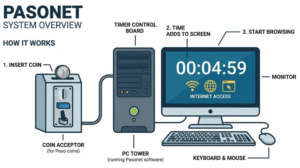 nternet System
In its essence, the Pasonet model works using the principle of a pay-as-you-go system. Customers insert coins into the slot, and the machine will then grant internet access for a specified time. When the timer expires, the system locks automatically until a new coin is added. This method has several benefits. It lets users manage the amount they spend. A person with a limited budget can still use online for just a couple of minutes without having to commit to a longer session. In addition, the system guarantees the fair use of the internet by stopping individuals from taking over the internet for long durations.
Its simplicity in design was among the main reasons Pasonet was so successful. There was no need for complicated accounts or payment systems. All you needed was a single coin and a short amount of time.
Technology Behind Pasonet Machines
Although the concept may appear straightforward, Pasonet machines rely on many components working in conjunction. The typical unit includes desktop computers and a timer that is operated by a coin, and Internet connectivity. Initial systems relied on dial-up connections; later versions made the switch to DSL or broadband to get faster speeds. Timer mechanisms play an essential role in ensuring that the computer is available. After a coin has been placed in the slot, the timer opens the system and begins counting down the time. If the timer runs out, the program automatically logs off the account and blocks access until the next coin is added.
Features That Made Pasonet Unique
Pay-Per-Minute Internet Access
The most ingenious characteristics in Pasonet included its micro-payments model. Instead of having users pay for huge time blocks, the system was able to allow extremely small transactions. One coin could give an hour of internet access, which was enough to perform tasks quickly like sending messages or examining emails. This model perfectly matches the habits of spending in the majority of communities, where people prefer to purchase services in smaller quantities rather than pay large initial expenses.
Accessibility for Low-Income Communities
Another advantage of Pasonet was its accessibility. Customers who didn’t have access to a personal computer or internet service were able to access digital resources by using these kiosks. Students utilized them for assignments at school, as job seekers sought jobs, and family members communicated with their relatives who live overseas. In reducing prices for connectivity, Pasonet played a key part in enhancing the quality of digital literacy and offering communities opportunities to grow and learn online.
The Cultural Impact of Pasonet
Community Internet Hubs
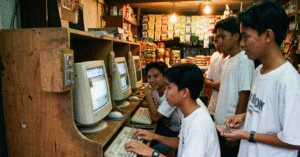
The machines of Pasonet quickly evolved into more than internet terminals. They were social spaces. Students would go to the machines after school to complete assignments or connect with friends on the internet. Gamers would use the devices to play multiplayer games and create vibrant communities that revolved with digital experiences shared by all. They also functioned as informal learning spaces in which people worked together to learn how to utilize the internet. Anyone who was able to establish an email account could help others in sharing their knowledge all over the community.
Gaming and Youth Culture
Gaming was a key factor in the success of Pasonet. Numerous young players frequented the kiosks in order to enjoy games online with their friends or strangers. The excitement of the competition, combined with the excitement of a short time, made every moment worth it. These experiences helped to shape the first online gaming culture in several communities, and introduced a generation of youngsters to the world of digital entertainment.
Pasonet as a Small Business Opportunity
Startup Cost and Setup
One of the main reasons Pasonet became so popular was its low start-up cost. The entrepreneurs only required a computer, internet access, and a timer that was operated by a coin. As compared to the opening of a complete Internet cafe, the setup was much less expensive and required a lot less space. A lot of small-scale store owners have included the Pasonet device in their business to draw more customers and to earn extra income.
Revenue and Profit Potential
Revenue models were straightforward, but they were effective. Every coin that was inserted into the machine was an amount of money to pay to access the internet. As time passed, these little payments became a steady income stream that was steady. The owners often install several units to boost their revenue potential, transforming small stores into mini-technology centers for their communities.
Advantages and Disadvantages of Pasonet
| Advantages | Disadvantages |
|---|---|
| Access to affordable internet | Limited privacy |
| Easy to establish as an enterprise | Older hardware can slow down performance. |
| Accessible to communities with low incomes | The location of the physical object is a factor. |
| Encourages digital literacy | It is less relevant in the smartphone age |

Although the traditional Pasonet kiosks are becoming less frequent, their fundamental concept is still relevant in the present. A lot of modern-day solutions concentrate on bringing affordable connectivity to communities that aren’t served.
For instance, public Wi-Fi networks, community internet programming, and mobile data plans are all geared towards the same goal, which is to make the internet accessible to all. A few entrepreneurs are investigating modern variations of the Pasonet idea that utilize more efficient connections with solar power, as well as electronic payment methods. These developments illustrate that the fundamental idea of having affordable access to technology still holds immense importance in today’s technological world.
Conclusion
Pasonet is more than an internet device that is operated by coins. It’s a solution to a global issue: how to afford internet access to people who are resource-limited. In offering users the option to pay for their internet time in smaller increments, Pasonet provided access to education, communication, and economic opportunity for thousands of individuals. While technology has advanced as smartphones are becoming more widespread, Pasonet’s legacy Pasonet remains significant. It reminds us that the most innovative ideas are not always a result of big corporations or sophisticated laboratories. In some cases, the most powerful ideas come from ordinary people looking for practical solutions.
FAQs
1. What does Pasonet mean?
Pasonet is generally a reference to internet kiosks that are operated by coins that allow users to pay small amounts of money to use online for a short duration.
2. Are Pasonet similar to Pisonet?
Yes. Pasonet as well as Pisonet are commonly employed interchangeably to define internet-based pay-per-use machines.
3. Are Pasonet kiosks still in use to this day?
A few kiosks are still in operation, particularly in areas where internet connectivity is not available, but they are becoming less popular because of smartphones and cheap mobile data.
4. How much does Pasonet internet cost?
Prices vary based on region, but many companies typically charge one cent for a few hours of Internet access.
5. What was the reason Pasonet was significant?
Pasonet helped to bridge the digital gap by making internet access affordable and accessible to students or workers, as well as low-income communities.